

- September 13, 2026
- by Will
- Content, AI
- 0 Comments
Most content strategies start with a topic and immediately assume it should become a blog post. Sometimes that is the right answer. Sometimes it creates a site with hundreds of informational articles while the pages closest to revenue remain thin, underdeveloped, or missing entirely.
The better question is: what type of page should exist for this opportunity?
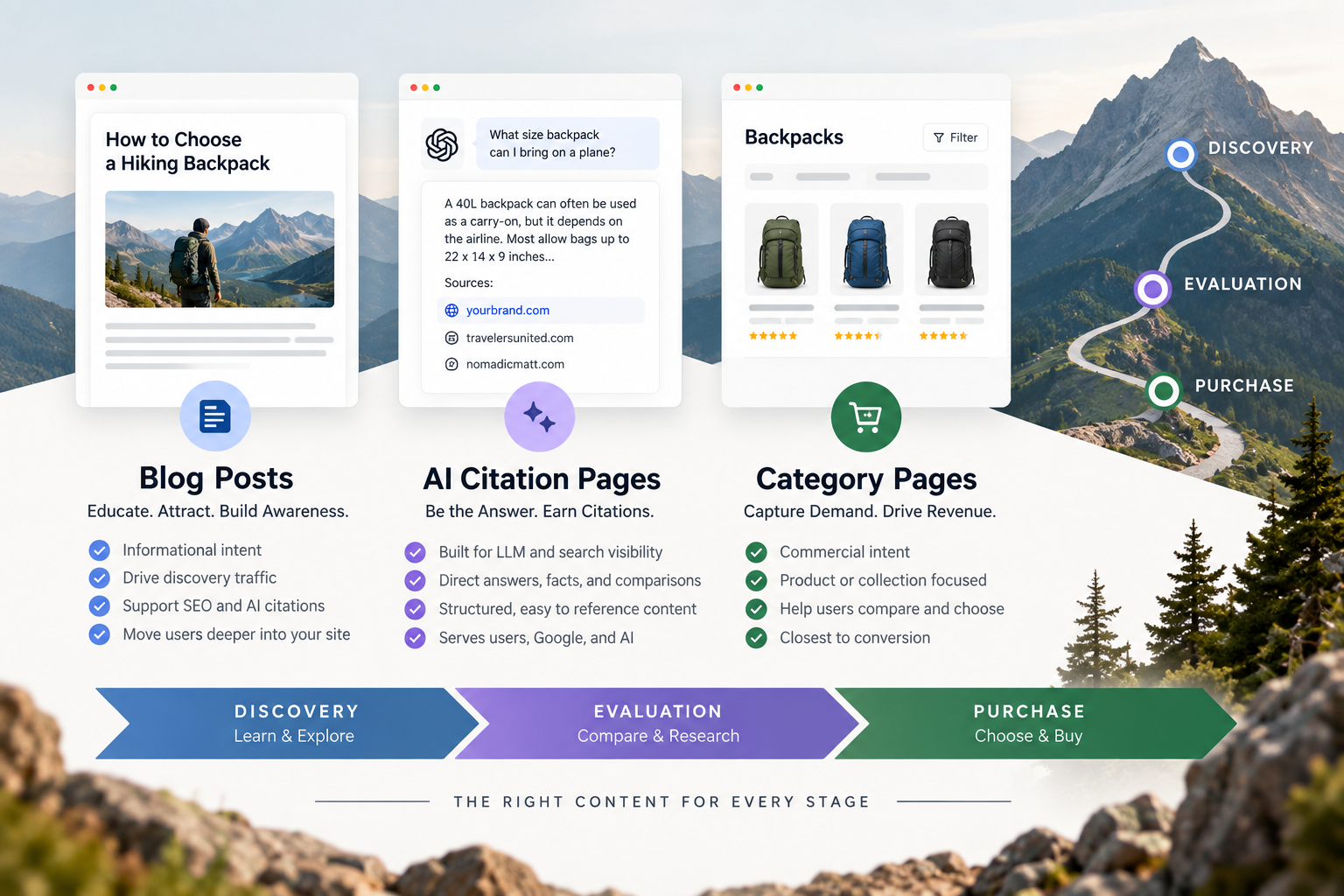
Blog posts, category and collection pages, and AI citation pages each play a different role. One helps capture informational search demand, another targets commercial intent, and another can make your information easier for generative AI systems to understand and reference.
Short answer: create blog posts when the user needs to learn, AI citation pages when a specific question or information gap needs a clear source, and category or collection pages when the user is looking for a type of product or service. The strongest content programs use all three across the buying journey.
Blog Posts, AI Citation Pages, and Category Pages at a Glance
| Blog Post | AI Citation Page | Category / Collection Page | |
|---|---|---|---|
| Primary goal | Educate and attract search demand | Become a useful source for AI-generated answers | Capture commercial demand |
| Typical intent | Informational | Informational or evaluation | Commercial |
| Funnel position | Top and middle | Mostly top and middle | Bottom |
| Best for | Guides, questions, education, research | Facts, comparisons, attributes, explanations, evidence | Products, categories, use cases, high-intent terms |
| SEO value | Rankings, topical coverage, internal links | Rankings plus citation opportunities | High-intent visibility |
| AI value | Can be cited when useful | Built to provide clear, citation-worthy information | Helps AI systems understand categories, products, and commercial context |
| Revenue proximity | Low to medium | Low to medium | High |
These are not hard boundaries. A strong blog post can earn AI citations. A category page can answer important questions. An AI citation page can rank in Google. The page type simply gives the opportunity a primary job.
What Is a Blog Post?
A blog post is usually the right format when the searcher is trying to understand a problem, research a category, learn how something works, or answer a question before choosing a product or service.
Good blog topics might include:
- What Size Backpack Can You Carry On a Plane?
- How to Waterproof Hiking Boots
- Merino Wool vs. Synthetic Base Layers
- How Long Should Hiking Boots Last?
Those searches matter even when the user is not ready to buy yet. A useful article can introduce the brand earlier in the decision, build topical coverage, attract non-branded search traffic, earn links, and become a source for AI-generated answers.
The blog post should not be the end of the journey
Informational content is most valuable when it connects naturally to the commercial parts of the site.
If someone reads an article about choosing waterproof hiking boots, the page should give them a clear path toward the waterproof hiking-boots category. If someone is researching carry-on backpack dimensions, the relevant carry-on collection should be easy to reach.
A blog can create discovery. It should also help the visitor move forward. Traffic that never connects to a commercial page can look good in analytics without doing much for revenue.
What Is an AI Citation Page?
An AI citation page is a useful way to describe content created around information that generative systems may need when answering a specific question.
It is not an “AI-only” page, and it should never be written for machines at the expense of the reader. The difference is that the page places extra emphasis on presenting information clearly enough that a system like ChatGPT, Gemini, Perplexity, or Google AI Overviews can understand and potentially reference it.
What makes an AI citation page different?
Depending on the topic, it may place more emphasis on:
- Direct factual answers
- Clear definitions
- Specifications and product attributes
- Comparison tables
- Well-defined entities
- Evidence and supporting sources
- Relationships between concepts
- Useful context around the answer
Example: “Can a 40L backpack be used as a carry-on?”
Basic content
A short article says that many 40-liter backpacks can work as carry-ons.
Citation-worthy content
A stronger resource explains common airline dimensions, the difference between capacity and exterior measurements, soft-sided versus rigid bags, domestic versus international considerations, and how to measure the pack correctly.
The second page gives a human reader more useful information and gives an AI system more specific information to understand and reference.
AI citation pages are not necessarily AI-only pages. A well-built resource can rank in Google, earn links, help users, and become a source for generated answers at the same time.
What Is a Category or Collection Page?
A category or collection page groups products, services, or closely related options around a commercial need. These pages are usually much closer to revenue than an informational article.
For an ecommerce site, examples might include:
- Waterproof Hiking Boots
- Men's Hiking Boots
- 40L Travel Backpacks
- Winter Hiking Socks
- Leather Hiking Boots
A service business may use service or solution pages to serve a similar role.
Why category pages matter
Someone searching for “why do hiking boots get wet?” is likely researching a problem. Someone searching for “waterproof hiking boots” has usually moved much closer to choosing a product.
Both searches can be valuable, but they serve different stages of the decision.
A site can publish dozens of blog posts and still neglect the pages closest to organic revenue. If the category and collection pages are thin, poorly structured, or missing entirely, producing more informational content may not be the highest-value next step.
Where Each Page Fits in the Content Funnel
Buyers rarely move from their first question directly to checkout. Different page types should support different stages of that journey.
Top of funnel · Discovery
Help the buyer understand the problem
Reach people while they are learning, researching, or asking AI systems broad questions.
Middle of funnel · Evaluation
Help the buyer narrow the options
Cover comparison, use-case, fit, alternatives, and buying questions.
Bottom of funnel · Commercial intent
Capture demand that is ready to act
Serve people looking for a specific type of product, service, or solution.
The funnel is not perfectly linear, especially now that buyers may move between Google, AI systems, review sites, and a brand's website. It is still a useful way to make sure the content portfolio covers more than just informational traffic.
The Biggest Mistake: Turning Every Keyword Into a Blog Post
One of the easiest ways to create content cannibalization is to treat every keyword like an editorial topic.
Imagine an ecommerce store already has a collection at:
/collections/waterproof-hiking-boots/
Then the content team publishes:
/blog/best-waterproof-hiking-boots/
If both pages are trying to satisfy the same commercial intent, the site now has two URLs competing to do the same job.
A better approach may be to turn the collection itself into the stronger search result by improving:
- Category copy
- Filters and merchandising
- Product attributes
- Buying information
- FAQs
- Internal links
- Supporting editorial content
Then use blog content for earlier-stage questions that naturally feed users toward that collection.
Should You Create a New Product Page?
Usually only when there is a real product reason to create one.
Creating duplicate or near-duplicate product pages simply to target more keywords can create thin content, confusing site architecture, and unnecessary indexation problems.
For many ecommerce sites, the larger scalable opportunity is creating or improving meaningful categories and collections.
For example, instead of creating another URL for the same hiking boot, the catalog may legitimately support collection pages such as:
- Wide Hiking Boots
- Waterproof Hiking Boots
- Hiking Boots for Plantar Fasciitis
Those pages can capture distinct commercial intent while organizing existing products in ways that are useful to buyers.
Can One Page Do More Than One Job?
Absolutely. In fact, the strongest pages often do.
Blog post + AI citation source
A detailed informational guide can rank in search and become a source for AI-generated answers.
Category page + AEO
A collection page can provide concise answers around sizing, compatibility, materials, product attributes, or selection criteria without losing its commercial purpose.
AI citation page + SEO
A resource created because there is a clear generative-search information gap can also target traditional search demand.
The better question is not “Is this SEO content or AI content?” Ask what the page needs to accomplish and then build it to do that job well across the channels where it can reasonably earn visibility.
How to Decide What Type of Page to Create
Start with search intent
Is the person trying to learn, compare, select, or buy? The intent should influence the page type before the keyword volume does.
Look at revenue potential
Determine whether there is a direct commercial path from the query to a product, category, service, or other revenue-producing page.
Evaluate the AI citation opportunity
Look for questions where your expertise, product information, data, or comparisons could become useful source material for AI-generated answers.
Check the existing page inventory
If a page already exists and should own the topic, improve it before creating another URL that competes with it.
Look for gaps in the funnel
A site overloaded with informational articles may need more evaluation and commercial pages, while another site may need more early-stage discovery content.
Consider internal-link value
A strong supporting page can help users and search engines understand the relationship between informational content and the commercial pages it supports.
A Simple Content-Type Decision Framework
The user wants to learnQuestions, education, problem research, early-stage discovery
Blog post or AI citation page →
The user wants a precise answerFacts, dimensions, definitions, attributes, evidence
AI citation page →
The user wants to compareOptions, alternatives, use cases, pros and cons
Comparison, buying guide, or AI citation page →
The user wants a type of product or serviceCommercial category-level demand
Category / collection / service page →
The user wants one specific productProduct-specific commercial intent
Product page →
The right page already existsThe existing URL should own the topic
Improve the existing page →
You Need a Content Portfolio, Not Just a Blog
Businesses often say they need “more content” when what they really need is better coverage of the buying journey.
A mature content program may include:
Discovery
- Blog posts
- AI citation resources
- Educational guides
Evaluation
- Comparisons
- Alternatives
- Buying guides
- Use-case content
Commercial
- Category pages
- Collection pages
- Service pages
- Product pages where appropriate
These pages should support one another through internal linking rather than existing as separate content silos.
What Should You Create First?
Start with the biggest gaps closest to business impact, then work outward.
If an ecommerce store has hundreds of blog posts but weak category pages, improving the categories may deserve priority.
If the commercial foundation is strong but the brand has very little early-stage visibility, expanding top- and middle-of-funnel content may be the better move.
If competitors consistently appear in ChatGPT, Gemini, Perplexity, or AI Overviews while your brand is absent, investigate the questions being asked, the sources being referenced, and the information gaps that may be keeping your content out of those answers.
Content volume is not the objective. The objective is to create the right pages for the missing opportunities across discovery, evaluation, and commercial intent.
Blog Posts vs. Category Pages vs. AI Citation Pages FAQ
Are blog posts still good for SEO?
Yes. Blog posts remain useful for informational search demand, topical coverage, internal linking, authority building, and reaching buyers earlier in their research. The problem is not blog content itself. The problem is using blog posts for every opportunity regardless of intent.
Can blog posts get cited by ChatGPT?
Yes. A useful blog post can become a source for ChatGPT or another AI system when it contains relevant, clear, trustworthy information. A separate AI-specific page is not always necessary.
What is an AI citation page?
An AI citation page is content created around a specific information need with extra emphasis on clear answers, structured facts, comparisons, evidence, entity clarity, and useful supporting context. It is still written for people and can also rank in traditional search.
Are AI citation pages only for AI?
No. A strong AI citation page can attract search traffic, earn links, help users, and support other pages through internal linking. The name describes a strategic purpose, not an exclusive distribution channel.
Should ecommerce sites create more category pages?
They should create category or collection pages when genuine search intent and the product catalog justify them. Creating thin collections for every keyword is not the goal. The page should represent a useful product grouping that satisfies real commercial demand.
Can category pages rank for informational searches?
Sometimes, especially when the page includes useful buying information, FAQs, specifications, or selection guidance. Its primary job should still align with the commercial intent of the query.
Should I create a blog post and a category page for the same keyword?
Usually not when both pages would satisfy the same intent. That can create cannibalization. It is often better to let the category page own the commercial term and use supporting blog content for earlier-stage questions.
Are product pages good for SEO?
Yes. Product pages can rank for specific product, model, brand, attribute, and long-tail searches. That does not mean creating unnecessary duplicate product pages is useful. Existing product pages should be improved when they have meaningful opportunity.
How many pieces of content should we create each month?
There is no universal number. The right production volume depends on the size of the opportunity, the type and depth of the pages being created, publishing resources, and the broader content roadmap. Consistent production matters more than choosing an arbitrary article count.
Build the pages your buying journey is missing.
The best content strategy does not ask how many blog posts to publish. It asks which pages are missing from the buying journey.
Blog posts create discovery. AI citation pages make useful information easier to reference in generated answers. Category and collection pages capture buyers when intent becomes commercial. The strongest content programs connect all three.
Not sure what your site should create next? We can map the missing opportunities across traditional search, AI discovery, and commercial intent and turn them into a prioritized content roadmap.
Get your content roadmap
